Posts

Cool Map: The United States of the Home Ruler, from the Atlas of True Names

Image
I have been running across some incredible infomaps recently. Result: A new feature here on ISWYM. Here's today's Cool Map, created by  Stephan Hormes .  

Visualization Universe, courtesy of Adioma Labs

Image
Adioma Labs' 2017 meta-visualization is an interactive deep dive into methods, formats and tools.  Bad news: The original has languished for lack of upkeep and is  no longer available for user-guided exploration.   Good news: There's a YouTube demonstration of the viz, and if you're interested in the practice of visualization, it's well worth 50 seconds of your time. 

"We Didn't Start the Fire," graphed

Image
Pop music nerdery for the win. Thank you, Tom Lum .

Everybody loves visual information — especially Abraham Lincoln.

Image
Infographics are clearly having a cultural moment. They have become pervasive in newspapers, magazines, blog posts, and viral tweets; they appear on television and in advertising, in political campaigns and at art openings. As a Google search term, “infographic” has increased nearly twenty-fold in the last five years. Yet infographics have been popular, in one form or another, for centuries. The source of their power isn’t computers or the Internet, but the brain’s natural visual intelligence.  Gareth Cook , the editor of Best American Infographics 2013 , has put together a short but true summary of the history of information graphics. (Many of you who see this blog may know most of it already.) His striking lede recounts how much Abraham Lincoln valued his "slave map" (featured in an earlier blog post ). Lincoln's reliance on the shades of gray throughout the Confederacy made an enormous difference in his Civil War decision-making.  Fortunately it's rare that mos...

What Not to Do with Infographics, now in handy infographic form

Image
This is an amusing yet cautionary illustration that expresses exactly what I hate about so very many infographics. This approach dumbs down the information under the guise of making you smarter. Hat tip: VizWorld .

Listing information design's most pressing issues

At his blog, Michael Babwahsingh says a number of smart things about the current status and ultimate value of information design. Number 8 is an excellent sample of his sensible macro approach: 8. Commercialization For several years now, the infoviz/dataviz trend has become infused in popular culture; the influence of the information design aesthetic is everywhere, from movie sequences to music videos to art exhibits . Although the intent is often tongue-in-cheek , and may even indirectly promote information design, there is still a risk of diluting, muddling, or flat-out mocking a field that has yet to really define and take ownership of itself. News features and special issues on information design are becoming more common, particularly in the graphic design world, but the tendency is towards visual appeal and surface-level scans over deep investigation (examples include Grafik magazine’s April 2010 issue, Eye Magazine’s Winter 2010 issue , and Fast Company’s Co.Design blog posts...

Infoviz for the people: Mass media mentions

Increasingly, it seems, mass media outlets are talking up infoviz. Great news for us here at Synoptical Charts, but more than that, helpful for people in businesses that demand clear, concise and logical communication. In other words, everybody. Today's installment, from Forbes.com : ...[W]hile Hadoop may be the poster child of Big Data, there are other important technologies at play. In addition to Hadoop, the open source framework for distributing data processing across multiple nodes, these include massively parallel data warehouses “that deliver lightening [sic] fast data loading and real-time analytic capabilities,” as the report states; analytic platforms and applications that allow Data Scientists and business analysts to manipulate Big Data; and data visualization tools that bring insights from Big Data analysis alive for end-users. Big Data is Big Market & Big Business - $50 Billion Market by 2017

Recommended: a new review "zoo"

"A Tour Through the Visualization Zoo" is a fantastic introduction to some attractive and sophisticated new visualization formats. The article and illos were put together by Stanford's Jeffrey Heer, Michael Bostock, and Vadim Ogievetsky. Heer is an HCI/visualization genius whose journal articles I've been following with interest; Bostock is the whiz behind the D3 archive of javascript code for visualization. Run, don't walk. It's great.

Sociological mapping on a grand scale in London

Booth’s Maps are important documents of mass poverty, but by drilling down and giving huge amounts of detail, they do more than analyze it statistically,” said Beverly Cook, curator of social and working history at the Museum of London. “Many writers and artists of the time saw London as a divided city, split between rich and poor, but these maps show its complexities. In many respects, they give a more realistic portrayal of working class life in London than Charles Dickens’s novels. By making something so complicated seem straightforward, Booth’s Poverty Map was also a triumph of information design. It fulfilled one of design’s most useful functions — helping us to make sense of the world — by distilling an avalanche of information into a clear, coherent form. An Early Triumph in Information Design - NYT.com

Resource recommendation: an "illustrated chronology of innovations"

Michael Friendly and Daniel J. Denis have a wonderful interactive timeline on milestones in the theory and practice of data visualization. Be prepared to spend a lot of time there; it's a deep well. Milestones in the History of Thematic Cartography, Statistical Graphics, and Data Visualization

Installation:
Data communication through visualization

Check out Lauren Manning's installation/survey about data visualization methods. She has created and mounted 40-odd versions of a big yet easy-to-understand data set. Viewers can show her which versions attracted them most strongly, got them thinking, and so forth by marking up "experience cards" that show the array in miniature. My own faves tend to be those that illustrate the proportions of different foods in fresh ways (mostly in the Abstract/Complex quadrant of her matrix ), rather than just showing images and labeling them with numbers (the Simple/Literal quadrant). Among those I like best: Food by Line Weight Concentric Circles Shaded Box Chart Stacked Bar Chart and Mini Months At the same time, I found a few of the formats hard to grasp; one such is the Rainbow Diagram Full Circle . I don't understand the purpose of the connections or the meaning of the line width. It needs a legend, at the very least. Still, the photoset/installation...

Some people are tired of all the debt charts.

Alex Pareene, at Salon, for one: I can explain the magnitude of the federal debt pretty easily: The recession caused revenue to plummet, and tax rates have been very low for years. Plus wars. But I explained that with words. Who reads words? No one, unless those words have lines next to them, or colored bars. America's Deficit Chart Surplus -- Salon

US debt charts of note

Image
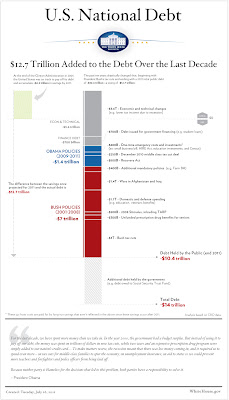
On Sunday, July 24, the New York Times ran a chart illustrating the fiscal results of national policy. Given the fierceness of the ongoing debt-ceiling debate, the chart got picked up and disseminated through the web, and with good reason: It's clear, it's straightforward, and it communicates something very important. (By the way, I have it on good authority that this was the first instance of color being used on the NYT editorial page.) You can see the chart here . Now, finally, comes the White House with this graphic : The Atlantic 's James Fallows likes it , but I'm less impressed. First of all, from a political point of view, it's a bit late to release this; the chart could/should have focused the congressional debate and the public discourse weeks ago. Secondly, despite the telltale Tufte-style typefaces and additional detail, it's not as intuitively readable as the Times' version. The timeline, such as it is, runs vertically, while the magni...

Quality dataviz about quality-of-life issues

Image
To accompany its Better Life Initiative , OECD (the Organization for Economic Co-operation and Development) has put up a handsome, carefully constructed set of interactive data graphics called the Better Life Index : There is more to life than the cold numbers of GDP and economic statistics – this Index allows you to compare well-being across countries, based on 11 topics the OECD has identified as essential, in the areas of material living conditions and quality of life. Each country is represented by a multicolored flower with 11 petals (OK, yes, potentially cheesy). The length of each petal represents the country's score in a given area; the width of the petal indicates the importance the user has assigned to that particular aspect. Drilling down into the details is easy to do; in fact, if you've a mind to do your own visualizations of this info, the underlying index data can be downloaded in spreadsheet format. Kudos to Moritz Stefaner , Jonas Leist and Timm Kekeritz (...

Infoviz in 2011: a status report

"I predict that we will see a lot more visualization in journalism. A lot of stories are already about numbers, with language mostly telling readers the conclusions. Simple charts with some interaction can provide a bit more context, and more can be added very easily. I doubt that we'll see a big visual journalism revolution in 2011, mostly because of the lack of accessible and practical tools, but we will see a lot more experimentation. The increasing demand will lead to more journalism-focused services being provided by visualization websites, in particular ones that also provide the analytic capabilities (i.e., not just pretty charts)." -- from " The State of Information Visualization, 2011 ," by UNC Charlotte's Robert Kosara . Emphasis added, as this is exactly What We Do here at Synoptical Charts.

Cool Map: Emissions worldwide

Image
From the Center for Public Integrity comes this interactive map showing greenhouse gas emissions from many of the world's largest economies. Lots of data is packed into this simple interface, and the map itself is blessedly clear. Note, though, that when it comes to infoviz issues, even these pros needed a do-over. Check out the message in the lower left corner. In an earlier version they made the common mistake of comparing circles based on radius, instead of by area. It's to their credit that not only did they fix the mistake, but they also owned up to it and made the change. The larger problem, though, is that distinguishing the relative size of circles is not easy for the average viewer; rectangles are clearer, and would probably have made this cool map even stronger. Note also that stats are from 2005. Since then there's been substantial economic growth in China (for example), so the current numbers are likely to be even higher than what's shown here. Diffe...

Cool Map: Lincoln's county-by-county map of slave population

Image
A sobering look at U.S. social conditions, circa 150 years ago. Notice how concentrated slave ownership is in the areas surrounding the major rivers (the Mississippi Delta is one obvious example) and near the largest ports (Houston, the Chesapeake region, Charleston). If you want more detail, there's a full frame version  courtesy of the New York Times .

Happy New Year: 2011

My New Year's gift to all y'all is this recommendation: RUN DON'T WALK to download  Google Refine . (No affiliation, just a satisfied customer.) Refine is an app that expedites data cleaning, thereby eliminating hours and hours of tedium and letting me get to the fun parts of the project sooner. Google Refine I will certainly be putting it through its paces this year.  If you do check it out, let me know what you think.

Practicing scales

Image
As a response to Kai Krause's Africa map , Jeffrey Winter shows us just how small Vatican City really is .  The True Size of Vatican City - xefer.com   [via The Power of Data Visualization ]

Hans Rosling's 200 Countries, 200 Years, 4 Minutes - The Joy of Stats - BBC Four